
Strong Enough to Hold
Beyond Toxic Positivity

A few months ago, I shared a short story on LinkedIn about a cherry tree in our backyard.
It was one of the first trees we planted when we began learning about regenerative gardening and permaculture. We were excited about cultivating a small food forest, one rooted in beneficial relationships—where each plant supports the health of the wider system.
And at first, the cherry tree thrilled us.
In its first two summers, it produced so much fruit. Branches heavy with bright red berries. We were amazed—and honestly, delighted. We ate them straight off the tree. We filled bowls. “This tree is thriving,” we said excitedly.
But looking back, we were so focused on the fruit that we missed what else was happening. The cherries had captured our attention. We didn’t notice what wasn’t growing—or what our version of support might be costing.
The slim wooden rod we had installed to help the tree stay upright was something we’d meant to remove after the first year. But we forgot—life got busy. By the time we took it off, it was too late. The trunk hadn’t grown strong enough to support the tree itself.
It bent. Then cracked in half.
Turns out, the tree had been directing all its energy toward production. The rod had done the work of holding the tree up, which meant the trunk never got the chance to grow strong.
In what seemed like a moment, it collapsed under the weight of its own productivity. In truth, the conditions had been building for some time.
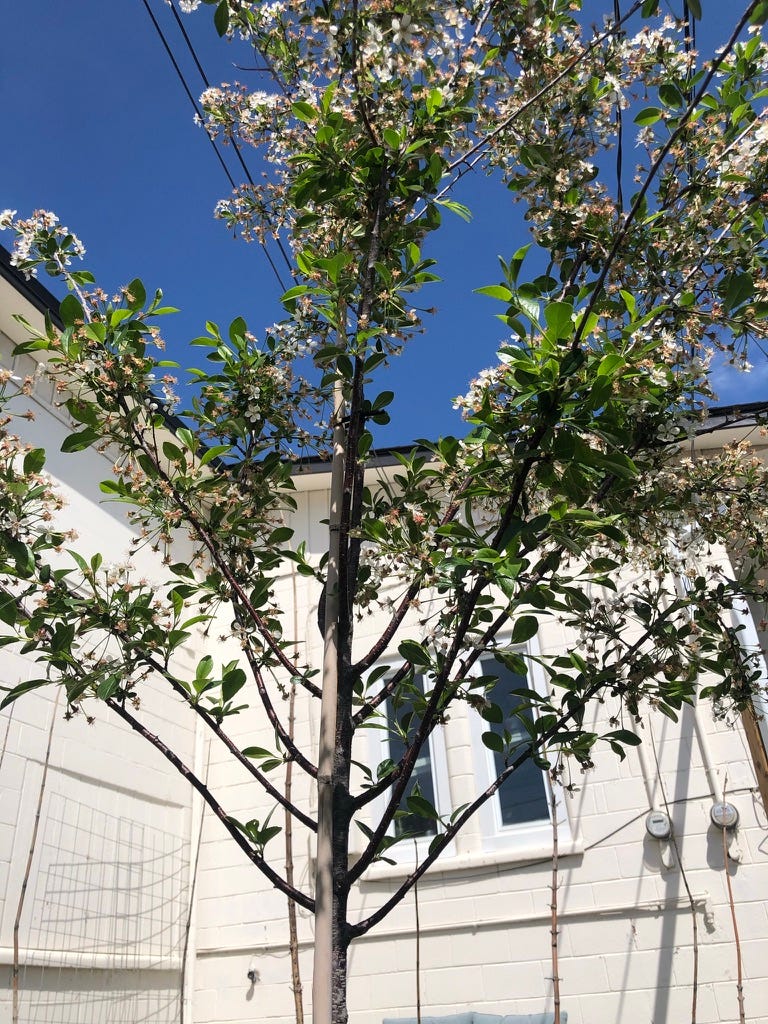
The fruit looks like success, until it doesn’t
This story has stayed with me; not just as a gardening lesson, but as a reflection on the systems many of us work within, especially in non-profit.
We often equate fruit with outward impact. We chase the bright red berries: the shiny outputs, the digestible success stories, the metrics that show we’re "doing more with less." And we’re often delighted (or pressured) by that production that we miss what else is being neglected.
Sometimes it’s not even outcomes we focus on, but outputs... volume and colour over depth.
And when we talk about resourcing, we tend to think of money from donors or funders. But there are other currencies at play: time, energy, focus, trust. Most of these are increasingly perceived as scarce.
We carve out time only for what’s directly linked to service delivery, to productivity. Time to reflect, pause, learn, or rest is too often seen as optional. Even the way we integrate technology (including AI) is often in service of speed, output, and capacity—not sustainability, wisdom, or depth.
We don’t just under-fund from a financial perspective. We under-resource time, growth, ability to breathe inside our organizational roles.
And slowly, the trunk weakens.
As Bayo Akomolafe observes, "not-for-profits, funding organizations, civic society organizations and NGOs have themselves become an industry of service-providers, PowerPoint presentations, proposals, prestige, slogans, and busy schedules. People very often take on the shape of that which they strenuously resist." (The Times Are Urgent: Let’s Slow Down)
What happens when we forget to build strength?
This is one of the reasons people burn out, and then we believe it’s our personal failing. I’ve been there.
“Burnout, in my experience, results from trying to give what I do not possess.”
— Parker J. Palmer, Let Your Life Speak
About ten years ago, I was in a senior leadership role in a non-profit. My phone was always nearby, just in case a critical incident happened. Even when the phone didn’t ring, I had already imagined the worst. I carried it in my body.
At the same time, I was working with funders who—while genuinely well-intentioned—continued to turn the volume down on resources while turning the volume up on expectations. We were constantly being asked to do more with less. Say yes when everything in our systems was begging for a pause.
And often, these funders held deep power-over our ability to say no. Some of the people we worked with are still long-time colleagues and friends. This isn’t a blame story—it’s a systemic one. Many of them were intermediaries for even more distant decision-makers. But the dynamic of power and productivity was real. It shaped every decision. It would also shape the decisions I made, as a leader.
I had just finished my Master’s in Leadership. I knew how important developmental work was—how necessary it was to grow strong teams, practitioners, and leaders. But I spent maybe 10% of my job doing that work - and typically in the unpaid time that creeps into social change work.
At one point, I started to believe I wasn’t cut out for non-profit or harm reduction work. That I was too soft, too slow, too tired.
But that wasn’t true.
I loved the work. I loved the people. I still do. It was (and is) deeply fulfilling, deeply human, deeply transformative.
What was being revealed wasn’t my capacity—it was the deeper misalignment in the system I was being tasked to sustain.
Whole systems leadership
This experience, along with many others, has shaped how I believe leadership must evolve.
At our organization, we’re growing more confident in naming what we’ve long felt: we don’t need more quick fixes. We need leadership that breathes.
We need what we call: whole systems leadership.
Leadership that tends to the roots, trunk, and surrounding ecosystem - as well as the fruit. That understands that growing strong teams, organizations, and leaders isn’t an “extra"—it’s essential. It's critical for the long haul.
At Invoke, we’ve been walking alongside teams who are asking these exact questions—and we’ve seen how much becomes possible when organizations make space for developmental work.
We’ve had the honour of witnessing organizations step off the productivity treadmill long enough to ask: What are we building? And can it hold the weight of what we’re trying to do?
They don’t stop producing.
They produce from internal and interconnected strength.
From intention.
From wholeness.
Seasons matter
In the garden, we’re learning this over and over again.
Health is seasonal. Trees don’t bear fruit all year long. They rest. They root. They strengthen. And while fruiting can be a sign of health, it can also be a stress response. Sometimes, a tree produces abundantly not because it is thriving, but because it is trying to survive. Without understanding the full system - the roots, the trunk, the soil, the seasons - we risk mistaking output for well-being.
As Bayo Akomolafe writes, the call to slow down is not about inaction, but about becoming "accountable to more than what rests on the surface... seeking roots... embracing the weird." It’s a shift from urgency to deeper responsiveness.
He reminds us that urgency often pulls us toward reacting to what's visible in the external world—toward fixing, acting, and controlling. But real strength in emergent times asks something different: a commitment to attuning to our inner world and to the ways we relate to and participate in the very conditions we're trying to change. When we become more accountable to those patterns—when we slow down enough to see our complicity and our choices—our actions become more powerful, more resonant, and more rooted.
So... perhaps we might shift from questions like how can we do more?
Towards:
What season are we in?
What would it take to grow strong enough to carry the work—not just once, but for the long haul?
What kinds of support do you participate in—however well-intentioned—that might actually prevent the development of strength or adaptability in yourself, your team, or your organization?
We don’t just need more harvest.
We need more health, more whole systems leadership.
And that means giving the trunk energy to grow.
We’re working with organizations who are ready to grow strong trunks and deep roots - who are re-imagining what sustainability might be like, beyond extractive productivity.
If this resonates, we’d love to hear how this connects with your experience.
What part of your system—personal or organizational—might be asking for more strength, rest, or support right now?
Feel free to share in the comments, or simply take a moment to pause and reflect.
Further reading from Bayo Akomolafe:
The Times Are Urgent, Let’s Slow Down
A Slower Urgency
Beautifully & compellingly put!